
When writing becomes a team sport: A middle school growth story
“All of my research showed me that writing needed to be a more collaborative task. Students had to see good models of writing from authors, but also from each other.”
In traditional classrooms, writing is often a solitary activity - sometimes even isolating. Students often stare at a blank document or graphic organizer, and despite having good ideas, do not know how to transition their thoughts to sentences on the page, feeling pressure to be perfect.
The desire to be an effective writing teacher for these students drove me to spend hours and money on professional development books, curriculum units, and webinars, researching the best way to teach students how to write. All of my research showed me that writing needed to be a more collaborative task. Students had to see good models of writing from authors, but also from each other. It was important for students to receive immediate feedback, but with so many students that often felt impossible. Then, one day, while scrolling social media, I discovered WeWillWrite, and it was a game changer. When I logged in for the first time, I knew I had to try it with my students.
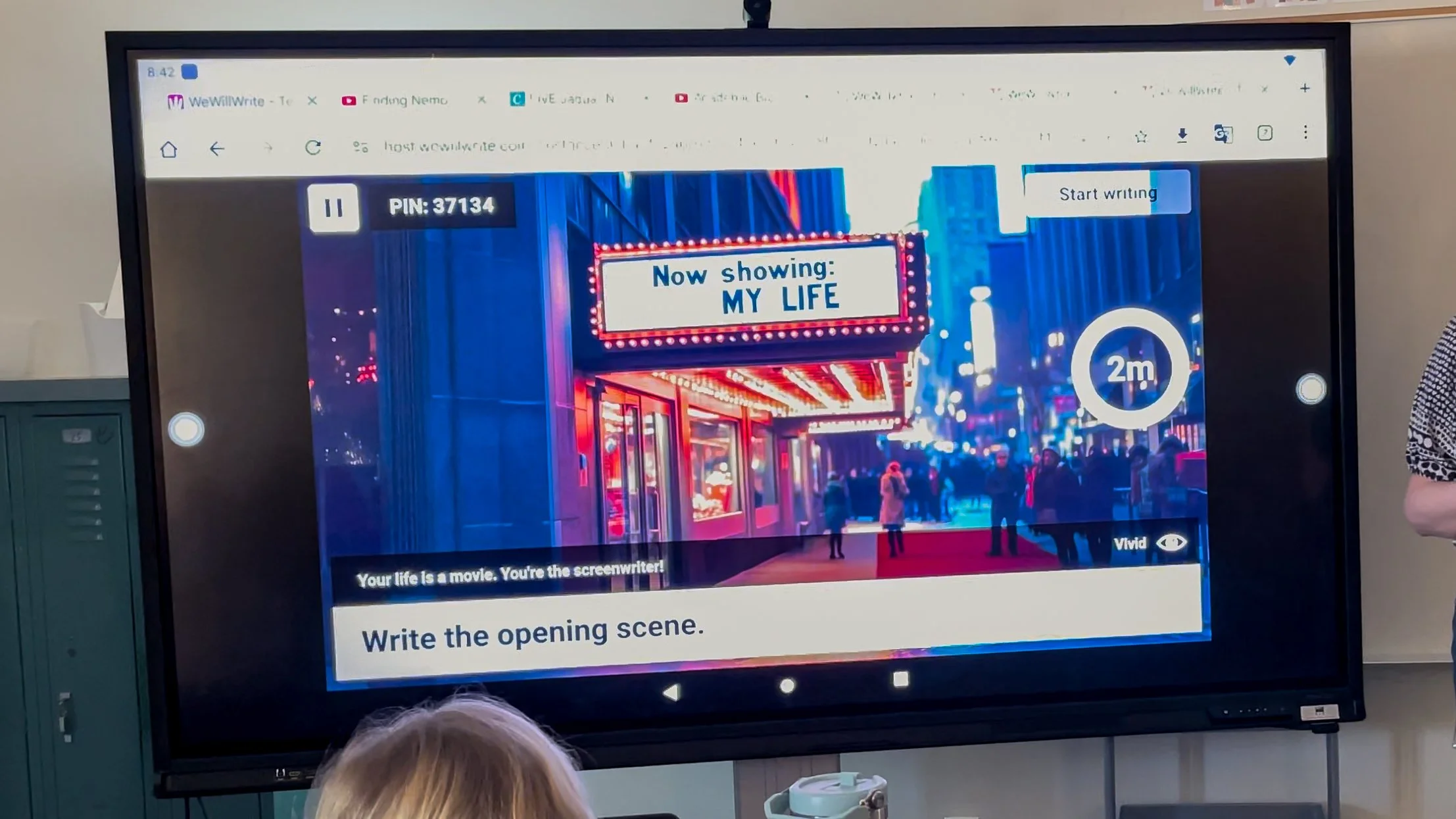
Students answer a WeWillWrite prompt without knowing who they’re on team with.
The shift: From blank pages to eager writers
“I watched once reluctant writers (…) eager to jump into the challenges and write in focused bursts.”
When I integrated WeWillWrite into our routine, I witnessed an immediate shift in the classroom energy. Writing was no longer a solitary chore. It turned it into a collaborative team sport, and fear was replaced by the joy of play.
By turning writing into a game, the platform effectively lowered the affective filter for my students. The anonymous nature of the challenges gave them the freedom to take creative risks and write without the fear of judgment.
I watched once reluctant writers who typically stared at a blank document or graphic organizer, eager to jump into the challenges and write in focused bursts which I think is key to it’s success. Students have to dive in immediately.
Beyond engagement: A tool that strengthens curriculum and assessment
“I now have formative assessment data that is invaluable for parent conferences and IEP meetings.”
At first WeWillWrite was a “fun game,” but soon I saw how it could be more than that. It could be an instructional tool to use alongside my curriculum to practice writing skills I was teaching: strong hooks, figurative language, sentence variety, and vivid imagery (to name several) all through a series of quick-writes meant to build fluency and stamina.
I even expanded its use into my history classes to review content and infuse literacy skills in the subject area. With the new teacher insights dashboard, I now have formative assessment data that is invaluable for parent conferences and IEP meetings.
Measurable results: Participation, stamina, and a culture of writing
“I see nearly 100% participation in challenges, increased word count and stamina, and a level of eagerness to write I haven’t experienced with any other platform.”
The impact WeWillWrite has had over the last year has been measurable. I see nearly 100% participation in challenges, increased word count and stamina, and a level of eagerness to write I haven’t experienced with any other platform.
There has also been a cultural shift. One student, seeing the platform on the board at the start of the year, exclaimed, “It’s a good day to be alive!” as he had used it in his elementary school classroom the year prior. My students will opt to stay inside during breaks just to finish a challenge or read their peers’ work. I haven’t experienced this type of engagement with any other platform.
Unlike with paper and pencil writing where feedback may be given a week later, the tool allows for instant feedback which students can then immediately apply to the next round. Concrete examples of figurative language or imagery are highlighted in real time helping to see what good writing looks like. I also see that they are getting better over time at writing to a prompt, something students often struggle with.
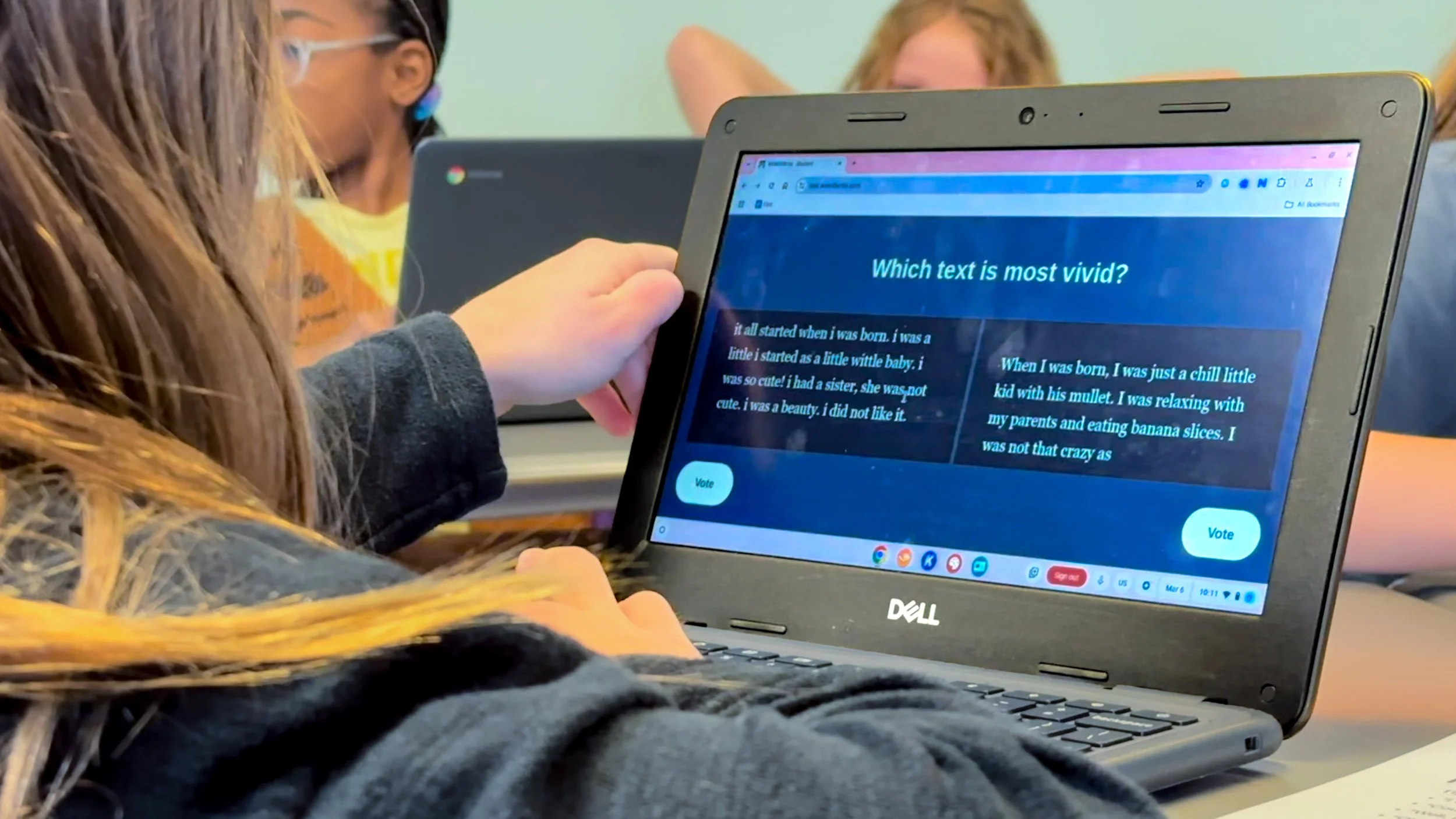
A student reading their peers’ work.
Get students started faster
Less hesitation. More participation. Stronger writing routines.
Preparing students for modern literacy: Writing as a collaborative skill
“They are developing the soft skills and digital citizenship needed for the professional world.”
Collaborative digital tools like WeWillWrite are necessary for modern literacy skills, and using the platform in my classroom has done more than just get my students to enjoy writing.
They are developing the soft skills and digital citizenship needed for the professional world where writing is rarely a solo act and more of a collaborative activity. They are learning to evaluate peers’ writing constructively and how to behave in a shared digital space.
WeWillWrite has been the perfect addition to my teacher toolkit. When used with purpose it can be a strong instructional tool. If used just for fun - on a minimum day, or when I have an unexpected ten minutes left at the end of class, students are doing something meaningful and practicing skills.
Teacher buy-in beyond my classroom
I have always valued collaborating with other teachers, and WeWillWrite is something I share often - especially on social media where educators connect to learn from one another.
Some of the most impactful teaching exists beyond the four walls of our school buildings, and creating a professional network of teachers has been meaningful to me over the last several years.
Through these connections, I have encouraged many teachers to try WeWillWrite in their classrooms. Their reflections below highlight the impact the platform has had in their classrooms.
“Beyond engagement, I’ve seen real growth in their writing skills. Students have become stronger writers and more confident thinkers. They’ve also learned how to give constructive, corrective feedback to their peers in respectful and meaningful ways—both positive and critical—something that can be challenging to teach. WeWillWrite has truly transformed the way my students approach writing, collaboration, and feedback, and it has had a lasting impact on my classroom. I really think it helped improve our state test scores! We love it!”
— DaVida Pegues-Winfrey, 9th grade, Forrest City High School, Arkansas
“I found that using WeWillWrite was instrumental in changing my students’ attitudes about writing from “one and done” to writing is rewriting because they could learn from seeing other’s attempts, and then discuss what works better, and immediately then apply it to their own writing.”
— Karen Gordon, Frank Augustus Miller Middle School, Riverside, California
“The student buy-in is incredible. I’ve also never had students beg to write before. As a teacher, I love the email reports I get after to see the percentage of students who like their own writing and the total word count. Over 6k words in 10 minutes? Amazing.”
— Nicole Zollman, 6th grade teacher, Southern Indiana
"We Will Write has been a game-changer in my classroom! Students are more engaged in the writing process, and as each step develops, I consistently see increased growth in both the strength of their writing and their overall output. They actually ask to do WeWillWrite in class which is an accomplishment in and of itself with 4th grade!”
— Maria DiAgostino Gallagher, 4th Grade, Franklin Elementary School, Roxbury, New Jersey
Want to see this happen in your classroom?
For school or team access, request a quote or book a short meeting.
